
If your team picks from racking or shelving, mobile safety steps are probably the most used piece of access equipment you own. They get pushed up and down aisles hundreds of times a day, so small differences in how they move and stop make a big difference to safety and to how quickly people can work.
The main choice is how the steps move and how they stop. This guide explains the four common systems, then how to pick the right height.
What are mobile safety steps?
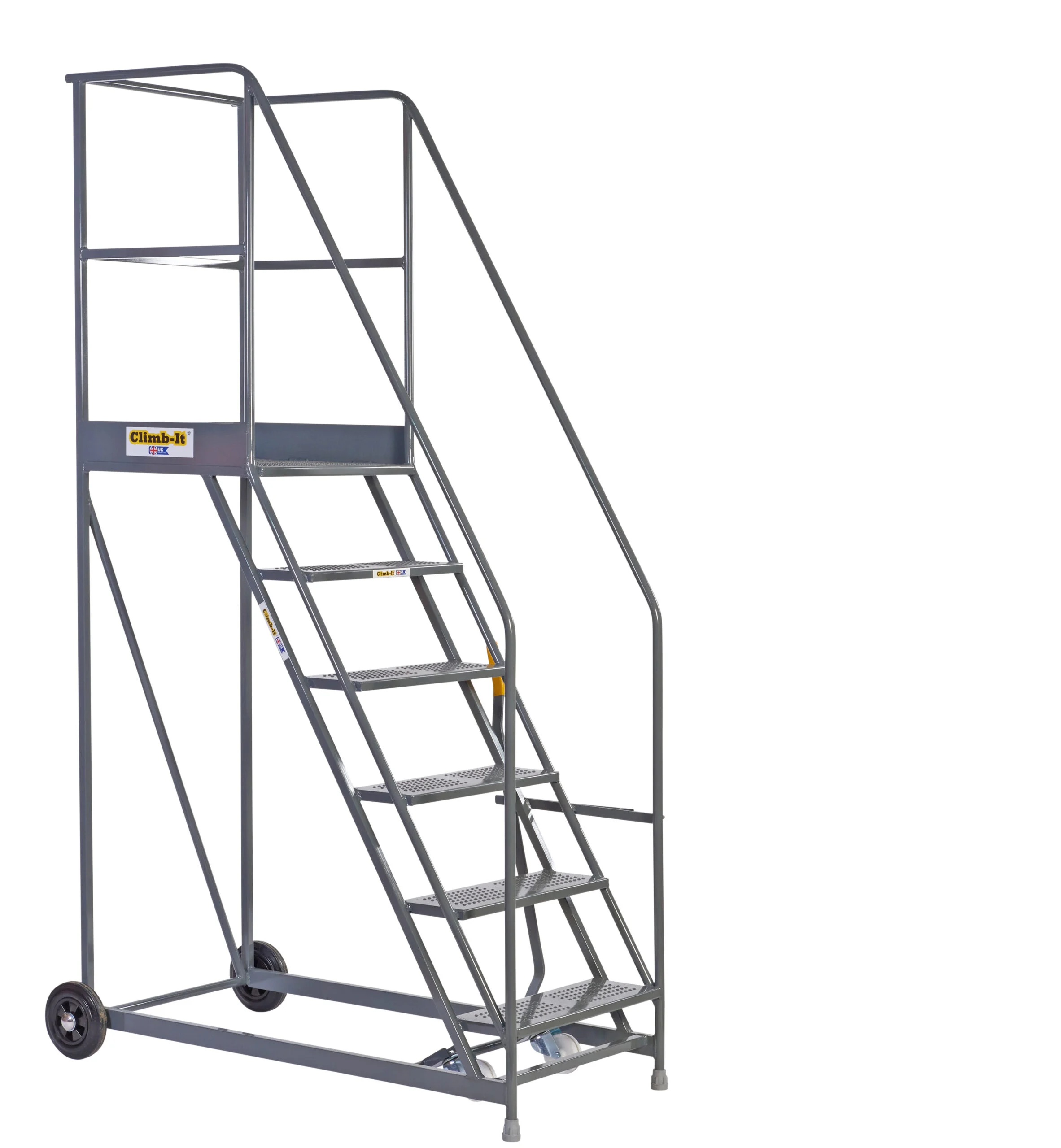
Mobile safety steps, also called warehouse steps or mobile ladders with a platform, are a fixed set of steps on wheels or castors, with a top platform and handrails. Unlike a stepladder they do not fold for use, so they are always ready and very stable.
They are covered by EN 131-7, the part of the ladder standard written specifically for mobile ladders with a platform. It sets requirements for the platform, the handrails and how the steps are kept still when someone is on them.
The four ways warehouse steps move and stop
Weight reactive steps
Weight reactive steps run on spring loaded castors. When nobody is on them, the castors hold the steps just off the floor so they roll easily. As soon as someone steps on, their weight compresses the springs, the castors retract and the steps sit down firmly on their feet. Step off and they are mobile again.
Nobody has to remember to apply a brake, which is why weight reactive steps are popular for busy picking areas.
- Climb-It UK weight reactive steps, steel, with 3 to 5 treads and platform heights from 720mm to 1160mm.
- Climb-It weight reactive safety steps, EN 131 Professional, with a 600 x 610mm enclosed platform and spring gates.
Spring loaded steps
Spring loaded steps work on the same principle, with smaller spring loaded castors that engage or disengage depending on whether weight is applied. They are typically lower and lighter, and very quick to move around.
- Climb-It UK spring load steps, with platform heights of 500mm, 750mm or 1000mm.
Hand lock steps
Taller steps are heavier and need to be firmly fixed before anyone climbs. Hand lock steps have a lever or handlock mechanism that lifts or lowers the front castors. With the castors engaged the steps roll. Release them and the steps stand firmly on their base.
They are the right choice for taller platforms and for floors that are not perfectly smooth.
- Climb-It UK warehouse steps, with platform heights from 750mm all the way to 3750mm.
- Climb-It UK warehouse essentials safety steps, with a 955mm handrail above the platform.
- Climb-It UK easy climb steps, with a shallower 50 degree slope so people can turn around and come down facing forwards.
Tilt and pull steps
Tilt and pull steps have wheels at one end. You tilt the steps back onto the wheels to move them, then set them down where you need them. Simple, with nothing to wear out, and good for lower heights.
- Climb-It UK tilt n pull steps, with 2 to 4 treads.
Which type suits you?
| Your situation | Best type |
|---|---|
| Lots of short picks, steps moved constantly | Weight reactive or spring loaded |
| Platform above about 1.25m | Hand lock |
| Uneven or older floors | Hand lock or tilt and pull |
| Users carrying stock down | Easy climb, with a shallow slope |
| Low reach, occasional use | Tilt and pull |
| Work needing an enclosed platform | Steps with spring gates, such as the Climb-It safety steps with safety lock |
Choosing the right height
Measure the height of the highest shelf people need to reach, then subtract about 2m. That is roughly the platform height you need, because most adults can reach comfortably to around 2m above where they are standing.
| Top shelf height | Suggested platform height |
|---|---|
| 2.75m | 750mm |
| 3.0m | 1000mm |
| 3.5m | 1500mm |
| 4.0m | 2000mm |
| 4.5m | 2500mm |
Check the aisle width as well. Taller steps have a longer base, and the steps need space to be positioned square on to the racking, not angled across the aisle.
Features worth paying for
- Wide, deep platform. Somewhere to stand comfortably and put a box down.
- Handrails on both sides. For holding on while climbing with one hand free.
- Kick boards. Stop stock and tools sliding off the platform.
- Anti-slip treads. Punched steel or serrated aluminium.
- Gates or chains on the platform. On taller steps, these close off the open side.
Looking after warehouse steps
Mobile steps need inspecting like any other ladder. Pay particular attention to the castors and braking system: a spring loaded castor that no longer retracts, or a hand lock that does not hold, turns safe steps into a hazard. Our ladder inspection checklist covers what to look for.
Frequently asked questions
What is EN 131-7?
EN 131-7 is the part of the EN 131 ladder standard that covers mobile ladders with a platform, commonly called mobile safety steps or warehouse steps.
How do weight reactive steps work?
They sit on spring loaded castors. Without weight the steps roll freely. When someone steps on, the springs compress, the castors retract and the steps rest on non-slip feet.
What height warehouse steps do I need?
Take the height of the highest shelf people reach and subtract about 2m. That gives the approximate platform height.
Are warehouse steps better than a stepladder in a warehouse?
For regular picking, yes. They do not need to be opened, are more stable, have handrails and a platform, and can be moved quickly along the aisle.
Need a recommendation?
Send us your top shelf height, aisle width and floor type and we will suggest the right steps. Call 01364 651860 or contact us. You can also browse all warehouse steps and weight reactive steps.