
Ask three people what the difference is between platform steps and podium steps and you will probably get three different answers. Catalogues do not help, because the names overlap. But the differences matter, because they decide how long someone can work safely and how much they can do with their hands.
Here is a straightforward way to think about the three main types of step, and which one suits which job.
The short answer
| Stepladder | Platform steps | Podium steps | |
|---|---|---|---|
| What you stand on | A tread, or small top platform | A larger platform with a high handrail | A large platform with guardrails all round |
| Hands free? | Not really | Partly | Yes |
| Best for | Short, quick tasks | Short to medium tasks | Longer tasks and two handed work |
| Typical standard | EN 131 | EN 131 | PAS 250 |
| Price guide (ex VAT) | From around £55 | From around £100 | From around £300 |
Stepladders
A stepladder is the one everyone knows. You climb it, stand on a tread, and steady yourself with one hand on the ladder or by leaning your knees against the top.
Stepladders are light, fold flat and are cheap. They are ideal for jobs that take a few minutes: changing a light fitting, reaching a high shelf, a quick look in a ceiling void.
Their weakness is the top. You should not stand on the top three steps, including a step forming the very top of the stepladder, unless there is a suitable handhold. That makes the usable height lower than people expect, and it is where most stepladder falls happen.
Good options:
- Folding steps with soft grip handle for light, everyday use, from £55.20 ex VAT.
- Climb-It aluminium swingback stepladders for trade and site use.
- Double Decker aluminium stepladder with tool tray, which has a large double step under the platform for more comfortable standing.
Platform steps
Platform steps, sometimes called platform stepladders, have a bigger standing area at the top and a high handrail or safety rail that rises above the platform. That rail is the important part. It gives you something to hold, and something to lean your thighs against, at the highest point.
They are a good step up from a stepladder for people who use steps all day, such as shop staff, maintenance teams and warehouse pickers. You can work more comfortably and reach higher safely, without the bulk of a podium.
Good options:
- Climb-It aluminium platform stepladders from £150 ex VAT.
- Professional aluminium folding steps with tool tray, with a 275 x 400mm platform and twin handrails.
- Climb-It fibreglass platform stepladders if you are working near electrics.
Podium steps
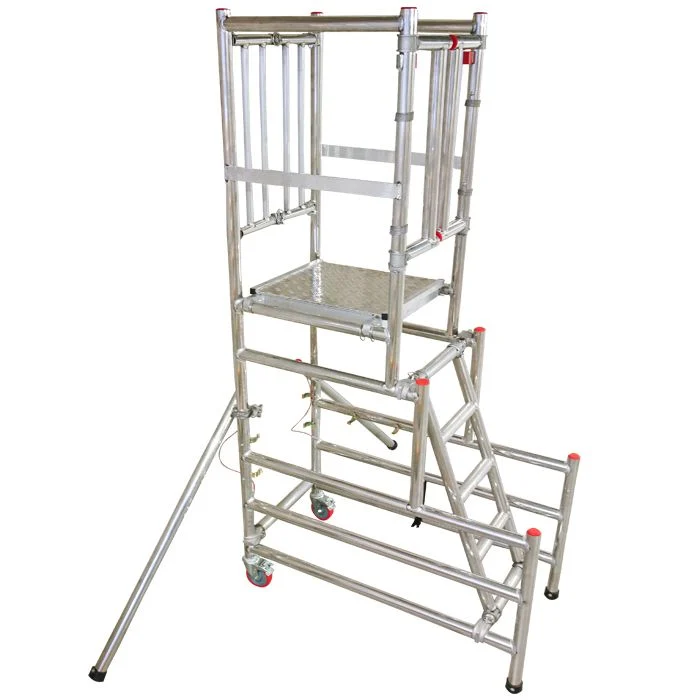
Podium steps give you a proper platform with guardrails on every side and a gate to get in and out. Once you are on the platform you are enclosed, so you can use both hands, turn around and work for longer without needing to hold on.
That makes them the right choice for work such as ceiling installations, decorating, cabling and shopfitting, where someone may be working at the same height for an hour or more. The HSE suggests looking beyond a ladder or stepladder if a job keeps someone on it for more than 30 minutes at a time, and a podium is often the answer.
Many podium steps are made to PAS 250, a specification published by BSI for low level work platforms with a single working platform, side protection and a platform height below 2.5m. It covers stability, guardrails, access and labelling.
Good options:
- Podium steps, certified to PAS 250, with a 670 x 670mm non-slip platform, 1000mm all round guardrail, saloon gates and braked castors. They fold in seconds and fit through standard doorways.
- Climb-It fibreglass podium steps from £306.65 ex VAT, with a high safety rail 950mm above the platform.
- Climb-It weight reactive folding podium steps, with castors that lock as soon as someone steps on.
Which should you choose?
Ask yourself three questions:
- How long will someone be up there? A few minutes: stepladder. Up to half an hour: platform steps. Longer: podium.
- Do they need both hands? If yes, go for a podium.
- How high do they need to reach? Your standing height should let the person work at chest to head height without stretching. Pick the platform height first, not the overall height.
As a rough rule, an average adult can reach about 2m above whatever they are standing on. So a platform at 1m gives a comfortable working height of about 3m.
When you need more height
If you need to work above what a podium gives you, or you need to work for long periods at height, look at a mobile access tower. Towers are built to EN 1004 and give you a large, guarded platform at greater heights, but they take longer to set up and need trained users.
Frequently asked questions
What is the difference between platform steps and podium steps?
Platform steps have a larger top platform and a high handrail. Podium steps have guardrails on all sides and a gate, so you are enclosed and can use both hands.
What is PAS 250?
PAS 250 is a BSI specification for low level work platforms, such as podium steps, with a single platform, side protection and a platform height under 2.5m. It covers stability, guardrails, access and labelling.
Are podium steps safer than stepladders?
For longer tasks and two handed work, yes, because the guardrails stop you falling off the sides. For a quick two minute job a good stepladder is perfectly suitable.
What height podium do I need?
Choose by platform height. Most people can work comfortably about 2m above the platform, so a 1m platform gives a working height of around 3m.
Still not sure?
Tell us what the job is and how high you need to reach, and we will recommend the right steps. Call 01364 651860 or message us.