

There is a persistent myth that ladders have been banned on building sites and in workplaces. They have not. The HSE lists it among its common work at height myths and is clear that ladders are a sensible, practical option for many jobs. What the law asks is that you think about whether a ladder is the right equipment for the task, and that it is used properly.
This guide covers what the rules actually say and the practical habits that prevent most ladder falls.
The law: Work at Height Regulations 2005
The Work at Height Regulations 2005 apply to any work where someone could fall a distance that could injure them. That includes standing on a stepladder to change a light fitting.
The regulations set out a simple order of thinking:
- Avoid working at height if you reasonably can.
- Prevent falls by using the right equipment, such as a podium or tower with guardrails.
- Minimise the distance and consequences of a fall where the risk cannot be removed.
Ladders sit within that. They are fine where a risk assessment shows the risk is low and the job is short, or where there are features of the site that mean other equipment is not practical.
When is a ladder the right choice?
The HSE describes ladders as suitable for low risk, short duration tasks. As a guide, if someone would need to stay up a leaning ladder or stepladder for more than 30 minutes at a time, look at other equipment.
| Task | Ladder? | Better option |
|---|---|---|
| Changing a light fitting | Yes, a stepladder | |
| Picking stock from a high shelf | Possibly | Warehouse safety steps with handrails |
| Two hours of decorating a ceiling | No | Podium steps or a mobile tower |
| Clearing a gutter | Yes, a leaning ladder, set up correctly | |
| Work needing both hands and heavy tools | Usually not | A platform with guardrails |
| Getting onto a flat roof | Yes, as access | Ladder extended 1m above the landing |
Setting up a leaning ladder
Most leaning ladder falls start at the bottom: the ladder slips out or tips sideways. Get the set up right and you remove most of the risk.
- Use the 1 in 4 rule. For every four units up, the base should be one unit out from the wall. That gives the 75 degree angle ladders are designed for.
- Firm, level ground. Do not stand the ladder on loose material, and do not prop the feet up on bricks or boxes.
- Secure it. Tie it, use a stability device, or wedge it. Having someone foot the ladder is a last resort.
- Extend it 1m above the landing if you are using it to get onto a roof or platform, so you have something to hold on to as you step off.
- Stand off the wall where needed. A ladder stay holds the ladder 300mm from the wall, keeping it off gutters and window frames and giving you a better working position.
Setting up a stepladder
- Open it fully and make sure the locking bars or catches are engaged.
- All four feet on the ground, on a firm, level surface.
- Face the work. Do not work side on, which puts sideways load on the steps.
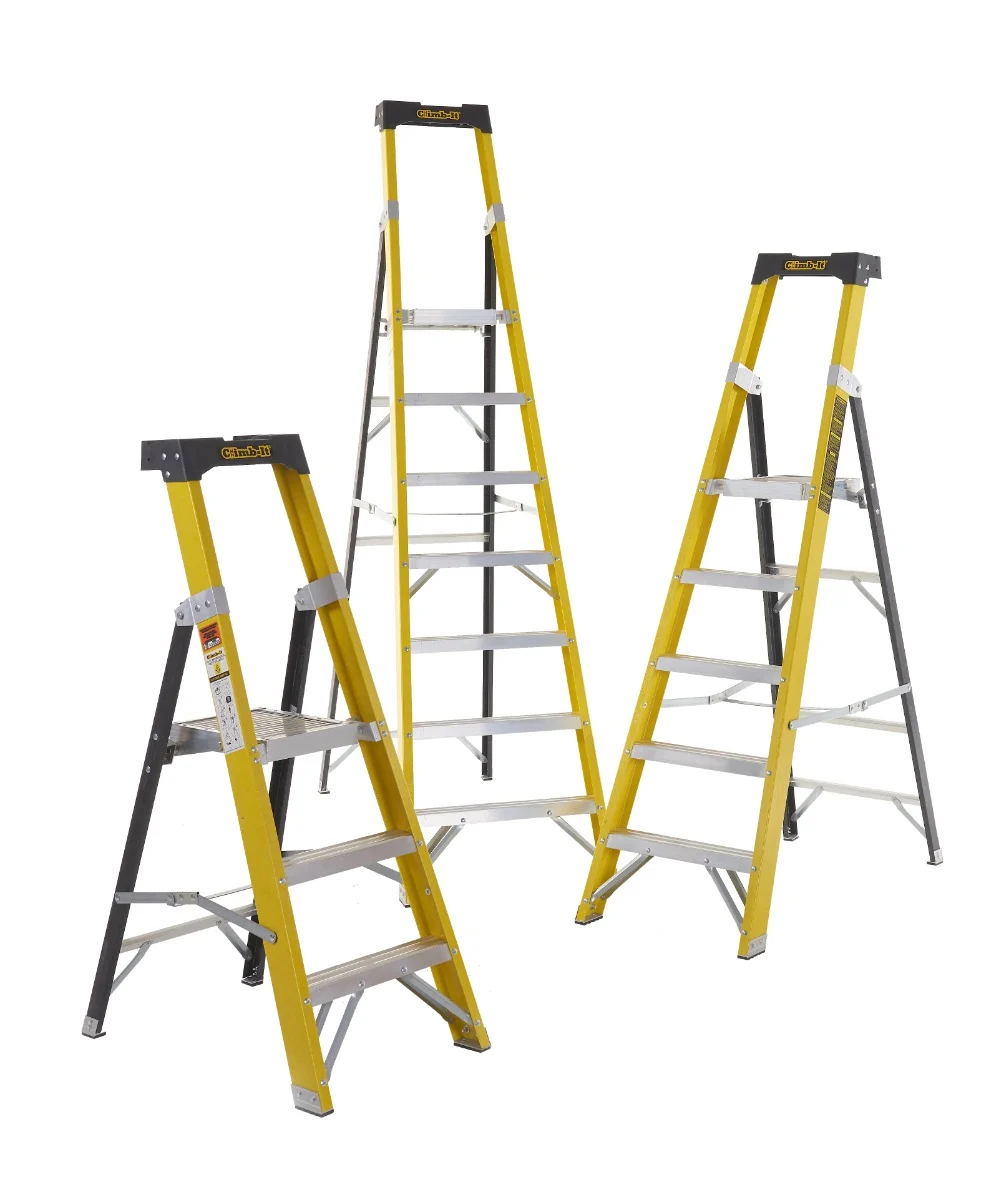
- Do not stand on the top three steps, including a step forming the very top of the stepladder, unless there is a suitable handhold. Platform stepladders with a high handrail are designed to solve exactly this problem.
Using any ladder safely
These habits apply whichever ladder you are using:
- Do a pre-use check every time. Our ladder inspection checklist shows what to look for.
- Keep three points of contact while climbing, and where possible at the work position. That means two feet and one hand.
- Do not overreach. Keep your belt buckle, or navel, inside the stiles. If you cannot reach, get down and move the ladder.
- Carry only light tools and materials. If the job needs heavy materials, you need a platform, not a ladder.
- Wear sensible footwear. Clean, flat soles with no mud or grease.
- Watch for overhead power lines. Keep ladders at least 6m away from overhead lines, and use a non-conductive ladder, such as fibreglass, for electrical work.
- Do not use a ladder in strong wind or bad weather outside.
Choose the right ladder for the job
A lot of ladder misuse comes from people using whatever ladder happens to be in the van. A stepladder used as a leaning ladder, or an extension ladder that is too short, encourages exactly the shortcuts that cause falls.
- For general work, a professional stepladder such as the Double Decker aluminium stepladder with tool tray.
- For reaching gutters and upper floors, an extension ladder with a stabiliser bar.
- For mixed jobs, a combination ladder that works as a stepladder, extension ladder or stairwell ladder.
- For longer jobs at low height, podium steps with all round guardrails.
Whatever you choose, make sure it is rated EN 131 Professional for workplace use.
Training
The HSE expects people who use ladders at work to be competent. For most people that means being shown how to check, set up and use the ladder they will be using, with a short refresher from time to time. The Ladder Association runs recognised ladder training courses if you want something more formal.
Frequently asked questions
Are ladders banned at work in the UK?
No. Ladders are allowed and can be a sensible choice for low risk, short duration jobs. You need to assess the risk, use the right ladder and use it properly.
What is the 1 in 4 rule?
For every four units of height, the base of a leaning ladder should be one unit away from the wall. That gives an angle of about 75 degrees.
How long can you work on a ladder?
As a guide, if a task would keep someone on a leaning ladder or stepladder for more than 30 minutes at a time, consider other equipment such as podium steps or a tower.
Can I stand on the top step of a stepladder?
Do not stand on the top three steps, including a step forming the very top, unless there is a suitable handhold. Platform steps with a handrail are a good alternative.
Talk to us
If you are not sure whether a ladder is right for a job, call us on 01364 651860 or send us the details. We can suggest the safest practical option, whether that is a better ladder or a platform.